10 words

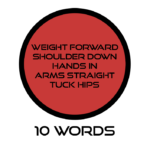
The swing in 10 words

Stack&Tilt created a 10 word template for the swing so we can condense the information down in the least amount of words. These 10 words become chapters for the golfer to organize all individual pieces of information. The words also function as a practice plan for on the range or easy reminders for when you go out and play.

WEIGHT FORWARD – SHOULDER DOWN- HANDS IN – ARMS STRAIGHT – TUCK HIPS

WEIGHT FORWARD

WEIGHT FORWARD

The WEIGHT FORWARD refers to the lower center/the location of lower body. Setup with the lower body forward helps the golfer with multiple things:

  1. It helps the golfer establish the low point forward
  2. It helps the golfer swing outward long enough to the ball
  3. It helps create a side tilt to replace extension for the purpose of keeping the inclination to the ground stable
THE HIERARCHY FOR WEIGHT FORWARD
  1. The location of the pelvis moves forward from the setup to the finish
  2. The lower center is forward at the setup
  3. The lower body is forward at the end of the backswing.
  4. The lower body moves forward earlier on the backswing in expert players than high handicap golfers

WEIGHT FORWARD LIBRARY

SHOULDER DOWN

SHOULDER DOWN

The degree of freedom downward and the side tilt is a major differentiator in golfers of different skill levels. SHOULDER DOWN refers to the tilted angle the shoulders turn on. This includes the backswing and the follow thru. The primary mechanism for SHOULDER DOWN is the tilt in the opposite direction of the turn.

The SHOULDER DOWN serves the purpose of:

  1. Keeping the inclination to the ground on backswing
  2. Keep the inclination to the ground on the finish
THE HIERARCHY FOR SHOULDER DOWN
  1. The lead shoulder moves down as well as in on the backswing
  2. The trail shoulder is down on the finish
  3. The trail shoulder is down and lower at impact

SHOULDER DOWN LIBRARY

HANDS IN

HANDS IN

Golf is played on a tilted angle. As such the hands move in an arc around the axis of the body, the spine. The hands don’t move in a straight line. 

  1. Moving the HANDS IN an arc, or on an angle to the ground, helps the golfer to create angular momentum (clubhead speed)
  2. Helps the golfer to swing outward to the ball

THE HIERARCHY FOR HANDS IN
  1. Hands in on the downswing
  2. Hands in on the backswing
  3. Hands in on the finish

HANDS IN LIBRARY

ARMS STRAIGHT

ARMS STRAIGHT

The degree and rate of flexion of the limbs is a major differentiator in golfers of different skill levels. The ARMS STRAIGHT refers to how the flexion/extension of the limbs serve to control the radius of the swing.

The ARMS STRAIGHT serves the purpose of:

  1. Controlling the radius of the arc for consistent control of the low point of the swing
  2. Assist in proper use of forces to keep the clubface closed to the arc and control of the dynamic loft
  3. Keeps the club moving outward and not swing across the ball
THE HIERARCHY FOR ARMS STRAIGHT
  1. Control the radius at impact
  2. Establish the radius at setup
  3. Control the radius at the finish
  4. Control the radius during the backswing

ARMS STRAIGHT LIBRARY

TUCK HIPS

TUCK HIPS

Extending the hips from the forward tilt established at address is a primary skill that distinguishes golfers of different skill levels.

  1. Pushing the hips forward and upward helps the golfer to learn to keep the lower body weight forward
  2. Extending the hips is a major power component of the ground reaction force that helps the golfer create power
THE HIERARCHY FOR tuck hips
  1. Hips forward
  2. Extending hips and replace with side bend from P5-P9
  3. TUCK HIPS on the backswing as part of the extending-flexing-extending-process

TUCK HIPS LIBRARY